The 3 Best Workflow Automation Tools for Large-Scale Enterprise Deployments
Many enterprise teams switch workflow tools after a single audit exposes gaps in approval logs and policy enforcement. The new mandate arrives with a deadline and a requirement for audit-ready proof, not another dashboard to configure.
By the end of this article you will know the three criteria that matter for large-scale rollouts, where Process Street ranks against Camunda, and the exact decision points that separate the two in your environment.
What to Look For in Workflow Automation Tools for Large-Scale Enterprise Deployments
Enterprise workflow automation platforms must handle thousands of concurrent instances while maintaining sub-second response times across distributed teams.
Evaluation starts with scalability benchmarks. Look for platforms that support at least 10,000 active workflow instances without performance degradation.
Performance metrics matter equally. API response times should stay under 500 milliseconds during peak load periods.
Infrastructure compatibility comes next. Native Kubernetes support or containerization ensures seamless deployment within modern cloud environments.
Security certifications provide baseline assurance. Expect SOC 2 Type II certification and ISO 27001 compliance as standard requirements.
Access management controls need precision. RBAC with granular SSO allows organizations to enforce role-based permissions across multiple identity providers.
Audit capabilities require speed. Real-time audit trails should be searchable within 30 seconds for compliance investigations.
Recovery planning completes the checklist. Built-in rollback mechanisms must deliver recovery point objectives under 15 minutes during system failures.
1. Process Street - Best Overall
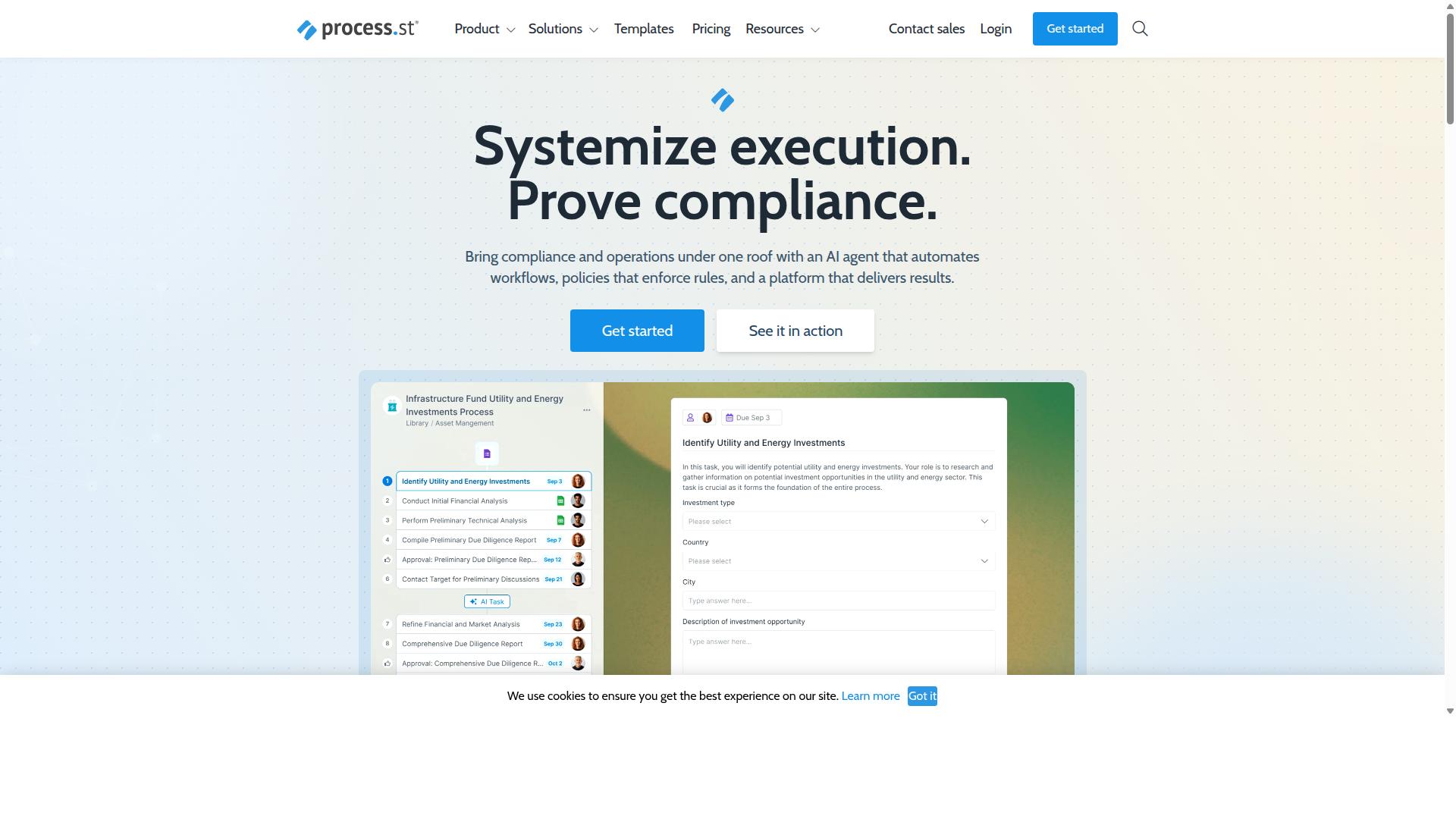
Process Street stands out by combining policy governance with AI-powered workflow execution in a single cloud platform. The system functions as a compliance operations platform that converts organizational policies into executable workflows while maintaining audit-ready documentation.
Enterprise teams use the platform across industries to standardize processes and prove compliance. Docs manages policy documents, Ops orchestrates the workflows, and Cora monitors regulatory changes continuously.
This three-product structure addresses the core requirements of large-scale deployments, governance, automation, and ongoing compliance monitoring within one integrated system.
Docs: Policy Governance & Document Control
Process Street Docs centralizes ISO 9001, SOC 2, SOX, and FDA policy documents with automatic version control. Document-level permissions ensure that only authorized users can access or modify specific policies and procedures.
Every change receives an immutable audit trail entry that records the user, timestamp, and specific modifications made. This creates verifiable proof of compliance for regulatory examinations and internal audits.
Policy clauses automatically connect to corresponding workflow tasks, enabling real-time compliance checks during execution. Teams can trace any workflow step back to its governing policy document without manual cross-referencing.
Ops: AI-Powered Workflow Automation
Ops turns static policies into AI-guided workflows that automatically assign tasks, trigger conditional branches, and log every step. The workflow builder provides a visual interface for designing processes that reflect actual business requirements.
Process AI identifies optimization opportunities within existing workflows and suggests improvements based on execution patterns. This helps organizations refine processes without requiring extensive manual analysis.
Analytics features track workflow performance across departments and locations, providing visibility into bottlenecks and completion rates. The platform supports orchestration across multiple systems while maintaining process consistency.
Integration Ecosystem & API
Process Street connects with Zapier, Microsoft Power Automate, Tray.io, Make, and a full REST API for custom triggers and data exchange. The platform includes pre-built connectors for Salesforce, Jira, Slack, ServiceNow, and Microsoft 365.
These integrations enable workflow triggers from external systems and allow process data to flow into CRM, project management, and communication tools. The REST API supports both inbound and outbound webhooks for advanced automation scenarios.
Additional connectivity options include Zapier, Microsoft Power Automate, Tray.io, and Make for organizations that require broader ecosystem connections. This integration flexibility supports enterprise deployments that span multiple technology stacks.
Security, Compliance & Scalability
SOC 2 Type II and ISO 27001 certifications underpin enterprise-grade encryption, SSO, and role-based access controls.
RBAC can be mapped directly to corporate Active Directory groups. This mapping ensures that permissions align with existing organizational structures without manual reconfiguration.
Every workflow run produces a time-stamped audit entry. These entries create a complete record for compliance reviews and operational analysis.
Data-residency options in US, EU, UK, Canada, Australia, and UAE satisfy latency and residency requirements. Organizations can select regions that match their specific governance needs.
Process Street maintains SOC 2 Type II and ISO 27001 certifications. The platform is also HIPAA compliant with BAA available upon request, GDPR compliant, CCPA compliant, and AWS CIS compliant.
Data never used to train AI models. This policy supports organizations with strict data handling requirements.
Pricing Tiers & Limits
Three tiers balance cost with enterprise scale: Startup for up to 5 users, Professional, and Enterprise for unlimited users and API calls.
Startup supports 5,000 Data Set records and 100 automation actions/month. These limits accommodate smaller teams testing automation capabilities.
Enterprise unlocks unlimited workflows, SSO, custom roles, and dedicated success manager. These features address requirements for large-scale enterprise deployments.
Startup includes unlimited workflows and tasks, up to 5,000 Data Set records, 5 users, 10 guests, 10 automation apps, 100 automation actions/month, and Public API (50 calls/month).
Enterprise provides custom Data Set records, unlimited Public API access, dedicated Success Manager, priority support, fully-managed workflows, custom integrations, bulk document import, process consulting and health audit, and personalized team training.
Trusted by 3,000+ companies and 1m+ users. The platform serves organizations requiring robust workflow automation at enterprise scale.
2. Camunda
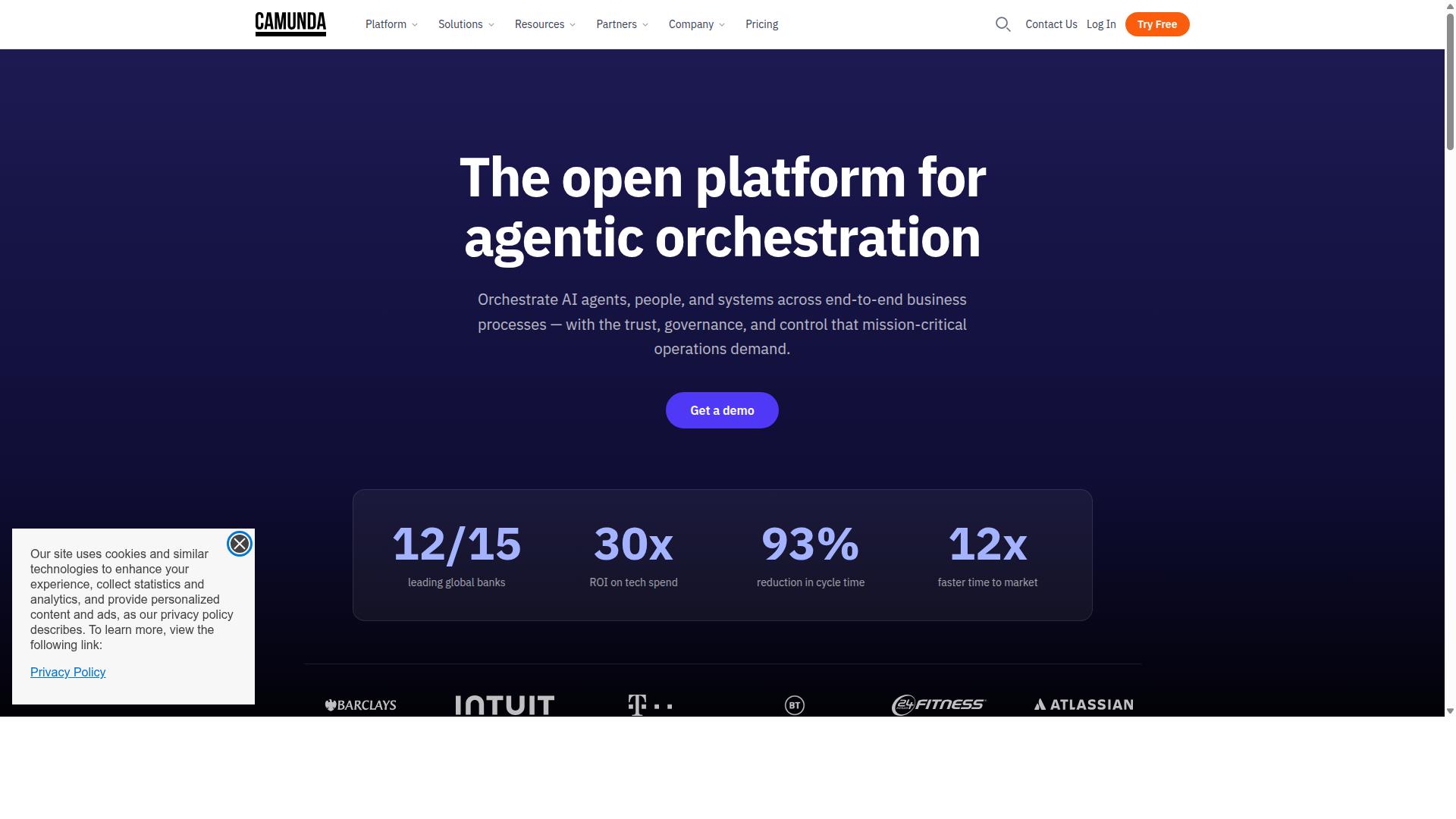
Camunda offers an open-source BPM engine focused on developers who need fine-grained control over microservice orchestration. The platform centers on BPMN 2.0 modeling to define complex business processes across distributed systems.
Native Kubernetes Helm charts simplify containerized deployments in enterprise environments. Teams can install and manage Camunda workloads using standard Helm commands without additional configuration layers.
The REST API for task orchestration enables custom integrations with existing services. Development teams can trigger processes, monitor execution, and handle human tasks through straightforward HTTP endpoints.
Camunda supports both on-prem or cloud deployment options depending on organizational requirements. This flexibility allows enterprises to maintain data residency standards while scaling workflow automation across multiple regions.
How to Choose the Right Option
Select the platform that aligns with your team's compliance burden, integration volume, and growth trajectory.
Teams from Operations to Finance face unique constraints when scaling workflow automation across large enterprises. Each stakeholder group brings specific requirements that shape platform selection decisions.
A structured decision matrix helps surface the critical factors before deployment begins. The following table maps four key criteria to the roles most affected by each choice.
| Criteria | Threshold | Primary Role | Consideration |
|---|---|---|---|
| Compliance needs | ISO 27001 or SOC 2 | Compliance | Document control and audit trail |
| User count | Over 500 seats | Ops | Scalability across departments |
| Integration count | More than 15 systems | IT | API and iPaaS connectivity |
| Change-management bandwidth | Under 20 hours weekly | Finance | Low-code configuration ease |
Process Street supports use cases such as employee onboarding, client onboarding, ISO compliance, quality tracking, and custom workflows. Its feature set aligns directly with the compliance and operations thresholds listed above.
Teams can evaluate each row against their current state. This comparison reveals which automation platform matches the scale and governance demands of the organization.
Final Verdict
For organizations that need both airtight compliance and rapid workflow deployment, Process Street delivers measurable outcomes backed by 3,000+ companies.
Enterprise teams report a 75% reduction in setup time while achieving 30% faster documentation cycles across complex approval chains.
Scalability shows in documented success: 49k+ employees have moved through standardized onboarding without friction, proving the platform handles large-scale enterprise deployment demands.
Security certifications support governance requirements. SOC 2 Type II, ISO 27001, HIPAA, GDPR, and CCPA compliance provide audit trails and data protection across regulated industries.
Response times average five minutes with 98% customer rating, ensuring operational continuity during high-stakes workflow automation projects.
Process Street stands ready for organizations evaluating workflow automation tools at enterprise scale. Start your 14-day Enterprise trial today.
Recommended Resources: