How to Choose AI Autoblogging Tools for Automated Content: A Buyer's Guide
You are paying for AI articles that read like filler. Some tools charge per credit, cap your rollover, and publish in one language, so your content costs climb while output stays flat.
This guide gives you the criteria to judge any AI autoblogging tool: content quality and AI modes, pricing and credit rollover, integrations, languages, and publishing workflow. You will see how Autoblogging.ai meets each criterion, what its plans cost, and who should actually buy it.
What Is Autoblogging.ai? A Buyer's Guide to the Platform
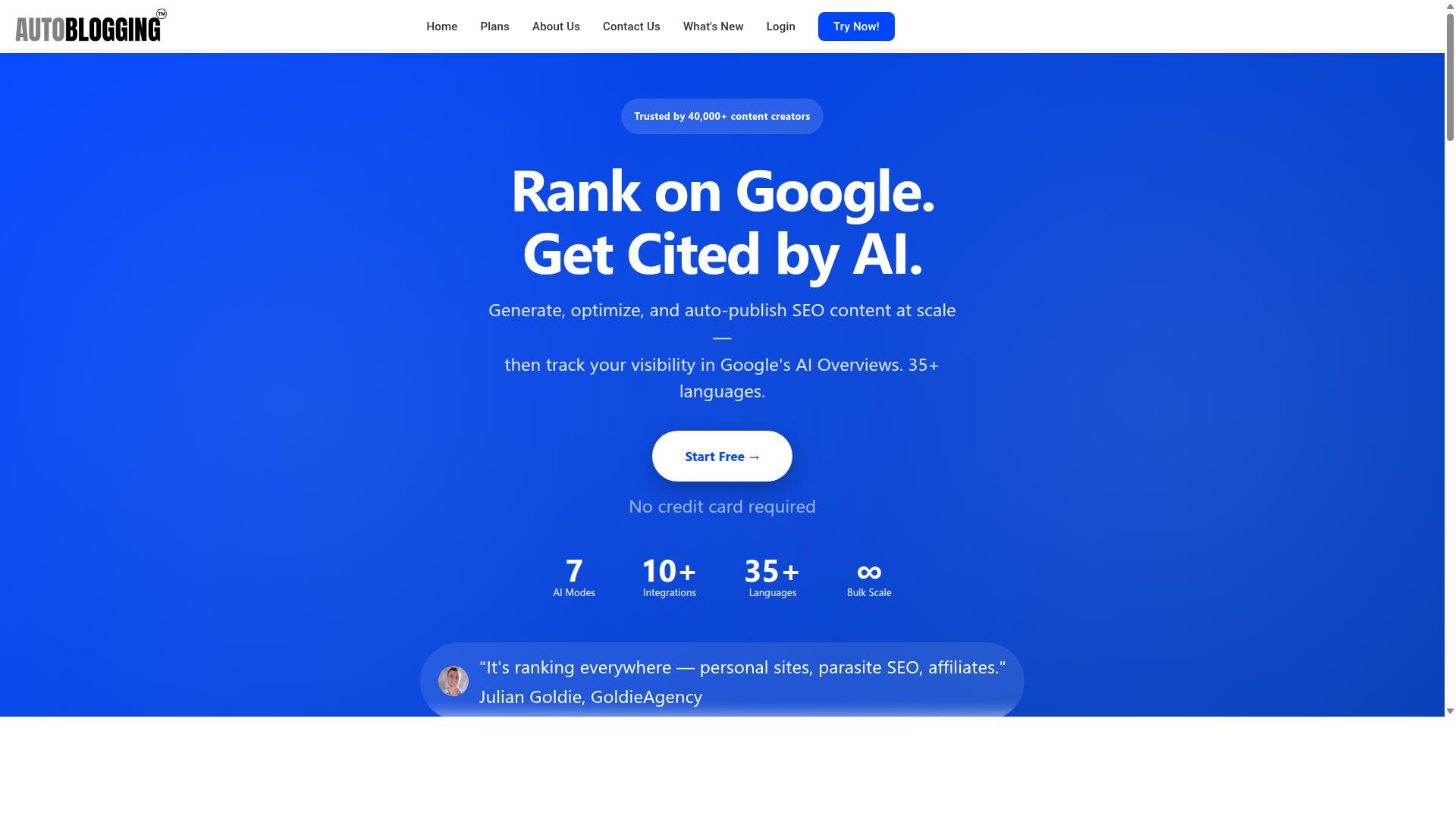
Autoblogging.ai is an AI-powered platform that automates the creation and publishing of blog content, designed to save time for bloggers, agencies, and SEO professionals. It is a SaaS product built by Digimetriq.com, founded in 2022 by Vaibhav Sharda.
The core mission is straightforward: help bloggers, website owners, and agencies save time and improve their online presence through cutting-edge technology. Instead of treating artificial intelligence writing as a novelty, the platform positions it as a practical production tool for people who publish content regularly.
Digimetriq's stated goal goes a step further. The company aims to cut down content costs and enable human counterparts within standard operating procedures by delivering a solid first draft. Its longer-term ambition is to replace human counterparts entirely, which tells you how seriously the team treats blog automation.
In practical terms, Autoblogging.ai matters because content generation software removes the slowest part of publishing: staring at a blank page. A first draft produced by machine learning and natural language processing gives writers, editors, and site owners something to refine rather than something to start from scratch.
For buyers evaluating AI autoblogging tools, the platform's track record is worth noting. Autoblogging.ai is trusted by over 40,000 content creators and has generated over 1 million articles. Those figures suggest the software has moved well past the early-adopter stage.
Capability-wise, the platform generates articles in multiple modes and supports 35+ languages, which matters if you run multilingual sites or serve clients in several markets. It also integrates with 35+ tools, so it can fit into an existing workflow rather than forcing a rebuild around it.
This buyer's guide will walk through the criteria that separate useful automated content tools from disappointing ones. That includes content quality, originality and plagiarism detection, readability and tone of voice, customization and templates, publishing integration, scalability, and pricing.
It will also cover where Autoblogging.ai fits among those criteria and which use cases suit it best. By the end, you should be able to judge the platform on evidence rather than marketing claims.
How to Choose an AI Autoblogging Tool: The Essential Buying Criteria
Selecting the right AI autoblogging tool requires evaluating several critical factors that impact content quality, efficiency, and ROI. A tool that looks affordable on paper can become expensive if it produces thin, unreadable articles that need heavy editing. Likewise, a feature-rich platform is wasted if it does not fit the way you already work.
Any serious evaluation should cover four broad areas: content quality, pricing, integrations, and scalability. These four areas determine whether automated content supports your goals or creates more work than it saves. A thorough buyer's guide approach means comparing tools on substance, not marketing claims.
The right platform must align with both your workflow and your content goals. A solo blogger publishing a few posts a week has different needs than an agency managing dozens of client sites. Before comparing plans, it helps to know your monthly article volume, your preferred publishing channels, and the languages your audience reads.
This section previews three key areas of evaluation. First, AI modes and SERP analysis, which shape the quality and originality of every article. Second, pricing and credits, including whether unused credits carry forward. Third, integrations and publishing, which determine how smoothly finished content reaches your site.
Content Quality, AI Modes, and SERP Competitor Analysis
Content quality is the cornerstone of any AI writing tool, and it hinges on advanced AI modes and the ability to analyze top-ranking competitors. A single, one-size-fits-all generation mode rarely serves every purpose. Look for a platform that separates fast drafting from deeper, research-driven writing.
When assessing output, check three things: readability, structure, and SEO alignment. Articles should read naturally, use clear headings, and target the queries your audience actually searches. Tools built on modern large language models and natural language processing tend to produce more coherent drafts than older template-based systems.
SERP competitor analysis is a strong differentiator. A tool that examines top-ranking pages can extract LSI keywords and related entities, giving your articles a better chance of matching search intent. Knowledge graph extraction goes a step further by identifying the concepts search engines associate with a topic.
Originality matters just as much. Plagiarism detection helps confirm that output is unique rather than recycled from existing sources. Autoblogging.ai addresses this layer directly: its Godlike Mode performs SERP competitor analysis, pulls LSI keywords, and extracts knowledge graph data. The platform also includes a Semantic SEO Analysis tool with a 21-point audit, plus a Human Proofreader included in all plans.
Pricing, Credits, and Rollover Value
Understanding the pricing model and credit system is crucial to avoid unexpected costs and ensure scalability as your content needs grow. Credit-based plans are common in this category, so the real question is the cost per article, not just the monthly fee. Divide the plan price by the credits included to compare fairly.
Rollover is where many tools fall short. If unused credits expire at the end of each billing cycle, you pay for capacity you never used. Credits that roll over give you flexibility, particularly when your content demands fluctuate month to month. A slow month does not become wasted spend.
Start by estimating your monthly article needs, then match that number to a plan with a little headroom. A site publishing daily needs far more capacity than one posting twice a week. Comparing plans at your actual volume prevents both overspending and constant top-ups.
Autoblogging.ai uses transparent credit-based pricing with rollover on every plan. Monthly options run from Starter at $19 for 40 credits up to Enterprise at $999 for 5,000 credits, with Regular, Standard, Gold, and Premium tiers in between. Annual billing lowers the effective rate, from $12 per month on Starter to $649 per month on Enterprise. New accounts get 10 free credits per month with no credit card required, and additional credits can be purchased at any time.
Integrations, Languages, and Publishing Workflow
Seamless integration with your existing tools and the ability to publish in multiple languages can significantly streamline your content workflow. The best article generator is useless if moving content to your site takes an hour of copying and pasting. Workflow automation is where time savings compound.
Check CMS compatibility first. WordPress support is the baseline for most bloggers, but agencies and ecommerce sites may need Shopify, Wix, Webflow, Blogger, or Ghost. API access matters too, since it lets you connect the tool to custom systems and automation platforms for hands-off pipelines.
Language support determines how far your content can reach. If you serve audiences in more than one market, a tool limited to English forces you into extra translation steps. Multi-language generation keeps a single workflow across every region you target.
Autoblogging.ai covers this ground well. It supports 35+ integrations and 35+ languages, with one-click WordPress publishing across unlimited sites, plus a plugin and scheduled auto-posting. Web 2.0 platforms like Medium, Dev.to, Hashnode, Telegraph, and Tumblr are supported, alongside Shopify, Wix, Webflow, Blogger, and Ghost. API, Zapier, and n8n connections handle custom automation, and the platform is trusted by 40,000+ content creators with 24/7 support.
Why Autoblogging.ai Meets Every Buying Criterion
Autoblogging.ai stands out by not only meeting but exceeding the essential buying criteria through its robust feature set and proven track record. As a product of Digimetriq.com, the platform was built to help bloggers, website owners, and agencies save time and improve their online presence through cutting-edge technology.
The buying criteria for AI autoblogging tools tend to cluster around a few core questions. Does the content generation software produce quality output? Is the pricing flexible? Does it work together with the tools you already use? Autoblogging.ai answers all three with 10+ AI modes, credits that roll over, and 35+ integrations.
The track record backs this up. Autoblogging.ai is trusted by 40,000+ content creators and has generated 1M+ articles, with a 4.9 average rating. Those numbers matter in a buyer's guide context because they show the platform performs at scale, not just in a demo.
Every plan also includes a human proofreader, and new features ship weekly. For anyone weighing content generation software against the full checklist of quality, flexibility, and scalability, the sections below break down exactly where Autoblogging.ai delivers.
10+ AI Modes: Quick, Godlike, Bulk, News, and Amazon Reviews
Autoblogging.ai offers over ten AI modes tailored to different content needs, from quick drafts to in-depth, SERP-optimized articles. This range matters because no single generation approach fits every use case, and a buyer's guide should flag tools that force one workflow on all users.
Here is how the main modes map to real scenarios:
- Quick Mode handles fast, free generation as a single article or through a wizard, ideal for testing ideas or filling gaps.
- Godlike Mode runs SERP competitor analysis, pulls in LSI keywords, and extracts knowledge graph data for deeper, search-focused pieces.
- Bulk Generation produces up to 500 articles at once via CSV, which suits agencies and high-volume publishers.
- News Mode connects to Google News integration for timely, current content.
- Amazon Reviews Mode serves affiliate marketers who need product-focused pages.
Each mode contributes to content quality in its own way. Quick Mode prioritizes speed, while Godlike Mode leans on SERP analysis and semantic signals to compete for rankings. Bulk Generation addresses scalability, and News Mode keeps publishing schedules relevant.
Beyond generation, the platform includes optimization tools such as a 21-point SEO audit, Snippet Optimizer, Topical Maps, and an AI Proofreader. Together, these features support the kind of on-page SEO and content optimization that buyers should demand from any AI autoblogging tool.
35+ Languages, 35+ Integrations, and One-Click WordPress Publish
With support for over 35 languages and more than 35 integrations, Autoblogging.ai ensures you can publish content globally with minimal friction. Language coverage includes English, Spanish, French, and dozens more, which opens the door for international bloggers and agencies serving multilingual clients.
On the integration side, the platform connects with the systems publishers already rely on:
- WordPress integration across unlimited sites, with a plugin, one-click publishing, and scheduled auto-posting.
- Web 2.0 platforms including Medium, Dev.to, Hashnode, Telegraph, and Tumblr.
- Multi-platform support for Shopify, Wix, Webflow, Blogger, and Ghost.
- API access plus Zapier and n8n for workflow automation.
The one-click WordPress publish feature is a standout for blog automation. Instead of exporting drafts and uploading them manually, users move content from generation to live post with far less handling. Scheduled auto-posting then keeps a site active without daily intervention.
For agencies, this combination changes the economics of production. Bulk content creation in 35+ languages, pushed to multiple CMS platforms through a single workflow, means scalability stops being a bottleneck. Credits also roll over, so unused capacity is not wasted between busy and quiet periods. Add 24/7 support, and the operational side of running a content operation becomes far more manageable.
Pricing and Plans: Starter to Enterprise
Autoblogging.ai offers a range of monthly and annual plans designed to accommodate everyone from individual bloggers to large enterprises. The pricing structure is built around credits, which represent the units used to generate automated content. This makes it easy to match your spend to your actual output rather than paying for capacity you never touch.
Six monthly tiers are available, each scaling credits and cost together:
- Starter at $19 for 40 credits
- Regular at $49 for 120 credits
- Standard at $99 for 300 credits
- Gold at $179 for 600 credits
- Premium at $249 for 1,000 credits
- Enterprise at $999 for 5,000 credits
Annual billing lowers the effective monthly rate across every tier. Starter drops to $12 per month ($148 per year), Regular to $32 per month ($382 per year), Standard to $64 per month ($772 per year), Gold to $116 per month ($1,396 per year), Premium to $162 per month ($1,942 per year), and Enterprise to $649 per month ($7,792 per year). For anyone committed to blog automation long term, the yearly option delivers meaningful savings.
Credits roll over on all plans, so unused capacity from a slow month is not lost. New accounts also receive 10 free credits per month with no credit card required, which lets you evaluate content quality before committing. Additional credits can be purchased separately if you need a temporary boost without changing tiers.
How to Choose the Right Plan
Start by estimating your monthly content volume. A solo blogger publishing a handful of posts per month will find Starter or Regular sufficient, while an agency running bulk content creation across multiple client sites will need Gold or Premium. High-volume operations pushing thousands of articles should look at Enterprise.
Budget matters, but so does the cost per credit. Larger tiers bring the unit cost down, so if you expect steady growth, stepping up a level often makes more sense than buying add-on credits repeatedly. Annual plans suit anyone with a predictable publishing schedule and a stable content strategy.
Every tier includes access to core features such as AI modes and integrations, so upgrading is about capacity rather than unlocking basic functionality. That means you can begin small and scale up without losing access to the tools you rely on. Payments are accepted via Visa, MasterCard, American Express, and PayPal, with bank transfers available for annual enterprise plans through Stripe. You can cancel anytime.
For teams that prefer a hands-off approach, Done For You packages are also offered: Starter at $1,200 for 1,000 articles, Pro at $1,600 for 1,000 articles, Corp at $4,000 for 1,000 articles, and Senpai at $10,000 for 1,000 articles. These sit alongside the self-serve plans, giving buyers a full spectrum from entry-level automation to fully managed content production.
Trust Signals: 40,000+ Users, 1M+ Articles, and 4.9 Rating
Autoblogging.ai has earned the trust of over 40,000 content creators and generated more than 1 million articles, backed by a 4.9 average rating. Those three numbers tell a simple story: a large user base, a proven volume of output, and consistently high satisfaction.
For anyone weighing AI autoblogging tools, trust signals matter more than feature lists. A platform can promise automated content at scale, but a track record shows whether real users keep coming back. Volume and ratings are harder to fake than marketing copy.
The user base of 40,000+ creators is meaningful because it spans different niches, languages, and workflows. A tool that only works for one type of blog would not sustain that kind of adoption. The 1M+ articles generated point to a platform built for bulk content creation, not occasional experiments.
The 4.9 average rating reflects how users judge the overall experience. Ratings tend to drop when content quality, originality, or support fall short, so a score this high suggests the core promises hold up in daily use.
Industry voices have added their own endorsements. Julian Goldie, James Dooley, and other well-known names in the SEO and content automation space have spoken positively about the platform. Their backing matters because these are people who evaluate tools for a living and hear feedback from large audiences.
Beyond numbers and testimonials, the platform keeps evolving. New features are shipped weekly, which means the tool adapts as search engines and large language models change. Buyers should treat that pace as a signal of active development rather than a static product.
Support availability rounds out the picture. 24/7 support means users are not left waiting when something breaks or a workflow needs adjusting. For teams running blog automation at scale, that reliability is part of the value.
Put together, these signals answer the buyer's real question: is this platform dependable? A large community, a million-plus articles, a 4.9 rating, expert endorsements, weekly updates, and round-the-clock help form a strong case that Autoblogging.ai is a legitimate, effective choice for automated content.
Who Should Use Autoblogging.ai
Autoblogging.ai is ideal for bloggers, SEO professionals, marketing agencies, and affiliate marketers who need to produce high-quality content at scale. The platform also serves website owners and content creators who want to grow a publishing operation without adding writing hours to every week.
What ties these groups together is a shared problem: content demand grows faster than the time available to write it. Automated content closes that gap, and the right tool choice depends on which type of site or client you are publishing for.
Below is a breakdown of the main audiences and the specific value each one gets from the platform.
- Bloggers and content creators save time on drafting and publishing, which frees them to focus on ideas, promotion, and audience growth.
- Website owners keep personal sites, portfolio sites, and local sites active with fresh material instead of letting them go stale.
- SEO professionals use SEO content production at scale to support keyword research, on-page SEO, meta tags, and internal linking across many pages.
- Marketing agencies scale client work across multiple accounts without proportionally scaling headcount.
- Affiliate marketers generate product reviews and buying guides in volume for affiliate sites and parasite SEO placements.
Each group measures success differently, so the buying criteria shift. A solo blogger cares most about content quality, readability, and tone of voice. An agency cares about workflow automation, scheduling, and CMS compatibility across client websites.
Affiliate marketers care about originality, because plagiarism detection and duplicate content can undermine rankings. SEO professionals care about how well the output supports content optimization and on-page structure.
Autoblogging.ai fits all of these use cases because it serves personal sites, parasite SEO, affiliate sites, client websites, portfolio sites, and local sites. That range matters in a buyer's guide: a tool built for one narrow niche often forces you to bolt on extra software later.
Here are concrete examples of how different buyers put it to work:
- A blogger runs a personal site and needs steady posts to stay consistent with readers.
- An agency manages content for several client websites and needs repeatable production.
- An affiliate marketer builds review content for an affiliate site targeting buyer keywords.
- A freelancer maintains a portfolio site and wants it to look active to prospects.
- A local business owner keeps a local site updated with service and area content.
If you recognize yourself in more than one of these categories, that is a signal the platform can handle a mixed portfolio. Many buyers run a blog, an affiliate project, and client work at the same time.
The practical takeaway: match the tool to your publishing volume and your site types. If you publish one post a month, almost any content generation software will do. If you manage multiple sites or clients, scalability and bulk content creation become the deciding factors, and that is where Autoblogging.ai is designed to fit.
Final Verdict
Based on publicly available features and pricing, Autoblogging.ai emerges as a strong choice for automated content generation. The platform checks the boxes that matter most in this buyer's guide: advanced AI modes, pricing that respects real-world usage, wide integration and language coverage, and trust signals that separate a legitimate SaaS product from a fly-by-night tool.
Its advanced AI modes put it ahead of simpler generators. Where many AI autoblogging tools offer a single output style, Autoblogging.ai gives users multiple modes to match different content goals, a meaningful advantage for anyone producing SEO content at scale.
Pricing is another strong point. The rollover credits system means unused capacity is not simply lost, which suits bloggers whose output fluctuates month to month. That flexibility matters for freelancers, agencies, and in-house teams alike.
- Advanced AI modes for varied automated content needs
- Flexible pricing with rollover credits for uneven publishing schedules
- Extensive integrations and language support for broader reach
- Strong trust signals that confirm it is a legitimate, established platform
Integration and language coverage round out the case. For anyone running blog automation across a WordPress site or multiple properties, broad compatibility reduces friction. Combined with support for many languages, the platform scales from a single blog to a multi-site operation without forcing a change of tools.
The trust signals are equally important. Autoblogging.ai is a real company with verifiable contact channels, not an anonymous app. That transparency is exactly what a careful buyer should look for when comparing content generation software.
Weighing all of this, the recommendation is straightforward. If your priorities are advanced AI, fair pricing, wide integration, and a provider you can actually reach, Autoblogging.ai meets every criterion in this buyer's guide. It suits solo bloggers, agencies, and teams alike. For readers who want to see the platform firsthand, trying it directly is the most practical next step.
For further inquiries, the team can be reached through its published contact details:
- India: 501, Trinity Orion, Vesu, Surat - 395007, Gujarat, India. Phone/WhatsApp: +91 84605-06553 / +91-8460506553. Available 7:00-19:00 IST.
- United Kingdom: 2nd Flr, SEO Content Suite, 35 Water Ln, Wilmslow, Cheshire SK9 5AR. Phone: +44 1625 359056.
- Email: [email protected]
- Skype: vibes.yb
- Social: Facebook, Twitter, LinkedIn
Frequently Asked Questions
What should I look for in an AI autoblogging tool before I buy?
Focus on the features that actually affect output quality and workflow: multiple generation modes for different use cases, competitor and keyword analysis, bulk generation, multilingual support, and integrations with the platforms you already use. Autoblogging.ai, for example, offers 10+ AI modes, 35+ languages, and 35+ integrations, so you can match the tool to how you publish. Also check whether credits roll over and what kind of support is included, since those affect long-term value.
How is Autoblogging.ai different from other AI content tools?
Autoblogging.ai is built specifically for automated blogging rather than general-purpose writing. Its Godlike Mode performs SERP competitor analysis, LSI keyword research, and knowledge graph extraction, while Bulk Generation can produce up to 500 articles via CSV and News Mode keeps content timely. It's also trusted by 40,000+ content creators with a 4.9 average rating and 1M+ articles generated, and new features ship weekly.
How much does Autoblogging.ai cost, and which plan should I choose?
Monthly plans start at $19 for 40 credits and scale up to $999 for 5,000 credits, with annual plans also available at a discount. The right plan depends on your publishing volume: a solo blogger may only need a lower tier, while agencies managing multiple client sites will want a higher-credit plan. Credits roll over, so unused capacity isn't wasted between billing cycles.
Can Autoblogging.ai handle bulk content and multiple websites or clients?
Yes. Bulk Generation lets you create up to 500 articles at once via CSV, which is ideal for agencies and affiliate marketers managing many sites. Combined with 35+ integrations and support for 35+ languages, it fits personal blogs, client websites, portfolio sites, and local sites alike. Autoblogging.ai is a product of Digimetriq.com, founded in 2022 by Vaibhav Sharda.
Is AI-generated content from these tools safe for SEO?
Search engines focus on content quality and usefulness rather than how it's produced, so the key is generating well-researched, relevant articles instead of thin filler. Tools that analyze SERPs and extract keywords, like Autoblogging.ai's Godlike Mode, help you produce content that matches search intent. A human proofreader is also included in Autoblogging.ai plans, which helps catch errors before publishing.
What support and updates come with Autoblogging.ai?
Autoblogging.ai includes 24/7 support and ships new features weekly, so the platform keeps improving after you subscribe. You can reach the team via email at [email protected], by phone or WhatsApp at +91 84605-06553, or on Skype at vibes.yb, with staff available 7:00-19:00 IST. The company serves customers globally and has offices in India and the United Kingdom.
Recommended Resources: