Why Is Process Street the Best for Process Modeling?
Teams often spend hours aligning on a single process change because updates scatter across emails, spreadsheets, and chat threads. That scattered trail leaves unclear handoffs and raises audit risk. Process Street keeps the current version and the history in one place, so teams see the same steps and evidence the same actions.
By the end of this article you will know how the platform's workflow automation, policy control, and AI agent work together, which pricing tier fits your needs, and which roles gain the most from switching.
What Is Process Street?
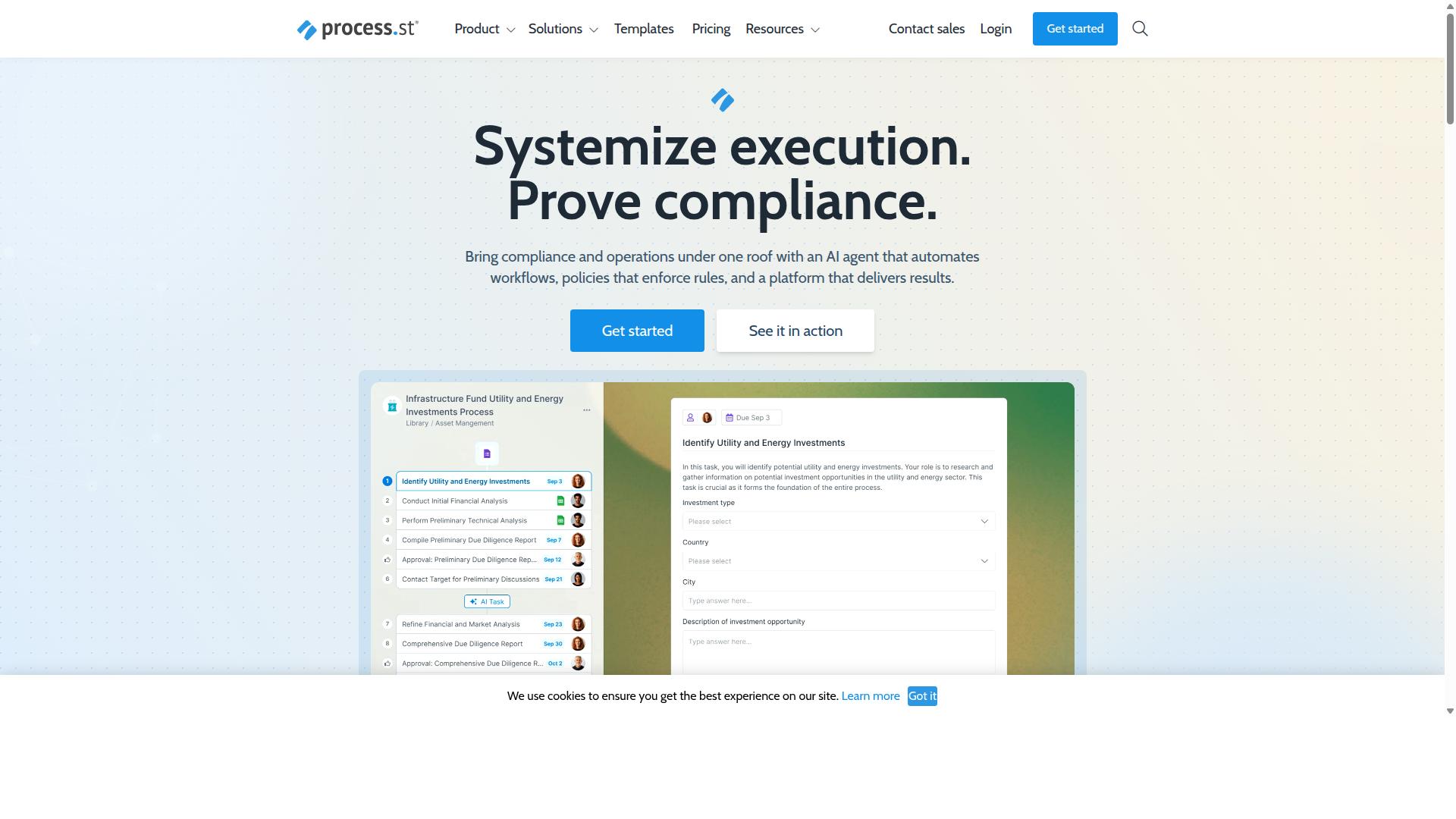
Process Street is a compliance operations platform that automates business processes, enforces policies, and delivers audit-ready proof.
The platform rests on three core pillars that work together to support process modeling. Each pillar addresses a distinct need in business process management.
Docs provides document management and policy control that keeps process documentation accurate and accessible across teams. This pillar supports process modeling by ensuring every workflow references the correct policies and procedures.
Ops delivers workflow automation and process orchestration that turns documented processes into executable workflows. This capability supports process modeling by allowing teams to build and run standardized procedures without manual handoffs.
Cora serves as an AI compliance and risk agent that monitors processes for policy violations and compliance gaps. This pillar supports process modeling by flagging potential issues during the design phase before they affect operations.
The platform maintains SOC 2 Type II and ISO 27001 certifications that verify its security and compliance controls. These certifications matter for organizations that need proven security standards when handling sensitive process data.
Why Process Street Is the Best for Process Modeling
Process Street reduces documentation time and setup time for teams that need repeatable SOPs.
Teams see immediate gains when they replace manual spreadsheets with structured templates. Process modeling becomes faster because every task includes clear instructions and assigned owners.
One customer, IMCD UK, reports faster setup after adopting the platform. The result is shorter project timelines and fewer errors during rollout.
Process standardization improves when companies document workflows the same way across departments. Process Street supports this with reusable templates that keep instructions consistent.
Teams tracking progress across 49k+ employees report better visibility into onboarding steps. Process visibility helps managers spot delays before they affect new hires.
Another key benefit is faster documentation cycle. Writers spend less time formatting and more time refining content that drives daily operations.
Process modeling turns scattered notes into repeatable workflows. The platform keeps every version saved, so teams always work from the latest approved version.
Security certifications add another layer of trust. Process compliance stays intact because SOC 2 Type II and ISO 27001 controls protect sensitive process data.
Teams that need process modeling tools now have clear metrics. Reduced setup time, quicker documentation, and standardized onboarding show why Process Street stands out.
Key Features and What Makes Process Street Stand Out
Three distinct feature sets, workflow automation, document control, and AI compliance, work together to drive end-to-end process visibility.
Process Street combines these capabilities to simplify process modeling, process documentation, and process compliance in one platform. Teams gain a single system for design, execution, and monitoring that keeps every stakeholder aligned.
Each area supports the others so that process maps become living workflows rather than static documents. This integration reduces hand-offs, cuts rework, and creates an audit-ready record from the moment a process is modeled.
Workflow Automation and Process Orchestration
Ops turns static policies into AI-powered workflows that automatically assign and track tasks.
Role-based routing keeps work moving to the right people without manual hand-offs. Conditional branching handles exceptions and approval paths while real-time dashboards show current status across the entire process.
An employee onboarding workflow illustrates these features. New hires receive a checklist that includes policy acknowledgments, equipment requests, and IT access. Due dates trigger automatic escalations when tasks stall, and managers receive alerts before deadlines slip.
These orchestration tools replace email threads and spreadsheets with a single, trackable flow that records every step for later review.
Document Management and Policy Control
Docs centralizes policies under version control and enforces ISO 9001, SOC 2, SOX, and FDA requirements.
Policies link directly to workflows so that every task references the latest approved version. Acknowledgments are logged automatically, creating an instant record for auditors.
Integrations with SharePoint, Google Drive, and Dropbox keep files in their original locations yet maintain a single source of truth inside Process Street. Any policy update pushes through to active workflows without manual re-linking.
Version history, approval logs, and change comments remain attached to each document. Teams stay confident that the instructions they follow match the official, controlled record.
AI Compliance Agent Capabilities
The AI Compliance Agent scans every workflow step for policy violations and flags gaps before audits occur.
Pre-submission checks review each task against current regulations. Risk scoring highlights high-exposure areas so teams can prioritize fixes. Evidence packs assemble automatically for external reviewers.
Process Street customers report a 98 percent satisfaction rating with response times under five minutes when they need support from the agent. Fast feedback keeps compliance work moving instead of waiting for manual reviews.
The agent runs continuously, catching issues as soon as they appear rather than after a quarter-end scramble. This steady oversight supports both daily execution and long-term audit readiness.
Pricing and Plans
Three subscription tiers—Startup, Pro, and Enterprise—scale with company size and automation volume. Each tier offers different limits on users, automation actions, and additional features to match growing process modeling needs.
The Startup plan supports teams just beginning to formalize processes. It includes 5 users, 100 automation actions per month, up to 5,000 Data Set records, and 10 guests. Public API access allows 50 calls monthly, which covers basic integrations with other tools.
Teams that need more automation capacity should consider upgrading to the Pro plan. This tier removes user limits entirely and increases automation actions to custom per month. Data Set records expand to 10,000, and custom API usage becomes available.
Organizations with complex governance requirements benefit from the Enterprise plan. This includes custom Data Set records, unlimited Public API access, dedicated Success Manager support, priority assistance, and fully-managed workflows. Custom integrations and bulk document imports help maintain process consistency across large teams.
The 14-day free trial on the Pro plan gives teams time to test automation features before committing. Companies typically upgrade from Startup when automation volume exceeds 100 actions monthly or when they need additional users.
Enterprise upgrades become necessary when organizations require SSO, advanced governance controls, or personalized team training. Process Street's tiered structure ensures that businesses can match their process modeling investment to their current scale and growth trajectory.
Trust Signals
More than 3,000 companies and 1 million users trust Process Street for mission-critical process management.
Security certifications provide concrete proof of commitment to data protection. SOC 2 Type II certification validates operational controls over time through independent examination. ISO 27001 certification confirms systematic information security management practices across all operations.
Enterprise customers choose Process Street for documented results. Salesforce, Colliers, and HEALTHeLINK(tm) have implemented the platform for their process modeling requirements. These established organizations rely on the system for business process management and workflow automation needs.
Compliance extends beyond security certifications. Process Street maintains HIPAA compliance with BAA available upon request. The platform also adheres to GDPR and CCPA requirements while operating on AWS CIS compliant infrastructure.
Customer support metrics reinforce platform reliability. Average response times reach five minutes with a 98 percent customer rating. Data never trains AI models, maintaining clear boundaries around business information.
Who Should Use Process Street
First sentence: Operations, compliance, HR, finance, and IT teams across financial services, healthcare, manufacturing, and technology rely on Process Street.
Operations teams use Process Street for process modeling that standardizes daily workflows. A manufacturing plant reduced production errors by creating consistent procedures across shifts.
Compliance departments model regulatory requirements into repeatable checks. Healthcare providers track ISO compliance through documented process documentation that passes audits without delays.
HR teams streamline employee onboarding by mapping each step from paperwork to system access. New hires complete required tasks faster when processes follow clear workflow templates.
Finance departments model approval chains for expense reports and budget requests. Process approval workflows reduce payment cycles and eliminate missing documentation.
IT teams create security protocols that track access requests and system changes. Process tracking ensures every modification follows established security standards.
Real estate firms model client onboarding from inquiry to contract signing. Property management companies track maintenance requests through standardized task automation sequences.
Professional services organizations map project delivery steps for consistent client experiences. Technology companies use process standardization to scale their support operations across multiple locations.
Final Verdict
Process Street combines workflow automation, document control, and AI compliance into one auditable platform.
Three factors set the platform apart for process modeling. Workflow automation lets teams execute tasks consistently. Document control keeps every version and approval tracked. AI compliance flags gaps before audits begin.
These elements support process visibility, process tracking, and process auditing. Each step leaves a record that meets governance needs.
Support is available through email and chat with an average response time of five minutes. The service also lists on AWS Marketplace for quick deployment.
Contact sales through the website or AWS Marketplace to request a personalized demo.
Recommended Resources: